

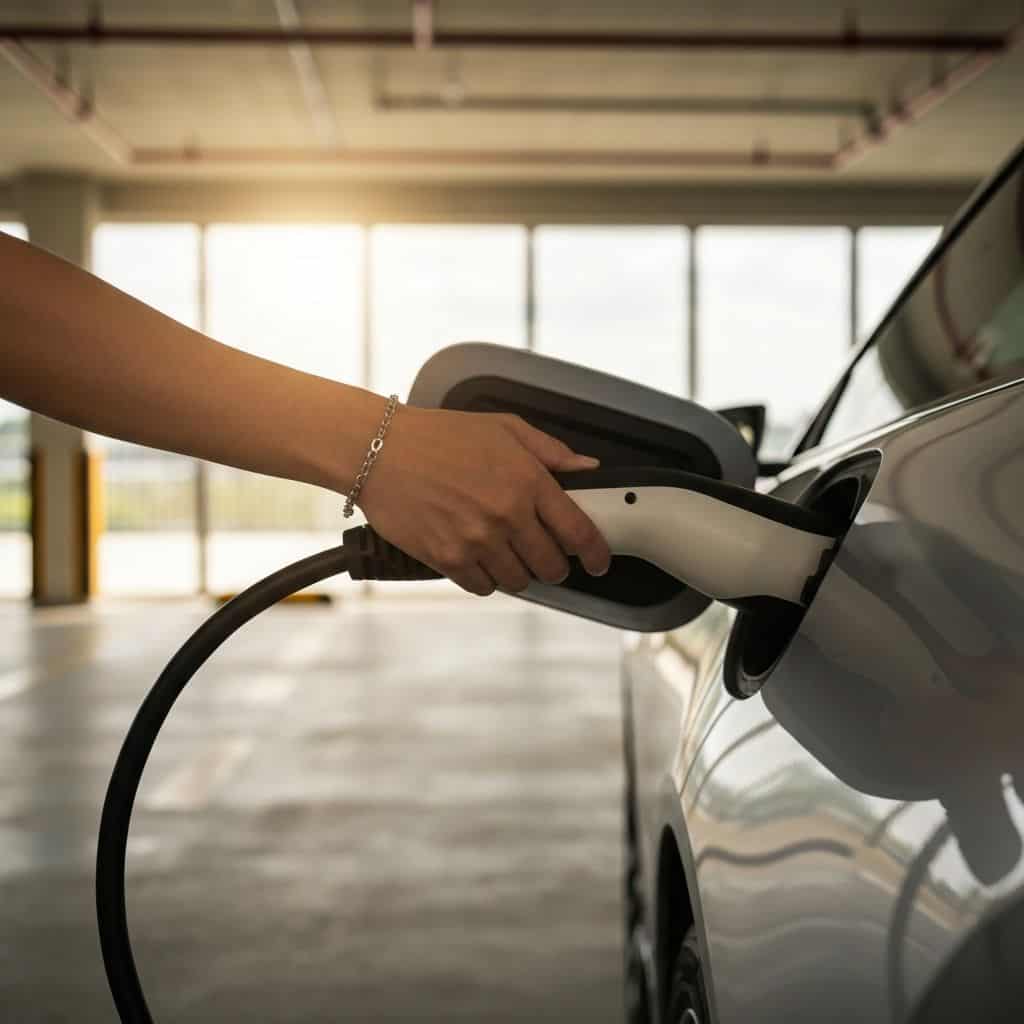
Developed with FractalEV, PlugOp Autocharge allows compatible Level 2 chargers to recognize an enrolled EV, authenticate the resident, start charging, and bill the correct account automatically—without requiring an app, card, screen, or any phone interaction.
Automatic vehicle recognition is common at select DC fast chargers but almost unheard of across Level 2 charging networks. PlugOp and FractalEV have created a new approach that brings the same plug-in-and-charge experience to multifamily residents.
Automatic vehicle recognition has remained one of the biggest missing pieces in Level 2 EV charging.
At nearly every networked Level 2 charger, a driver must do something after plugging in: open an app, scan a QR code, tap an RFID card, use a payment terminal, or interact with a screen. The charger supplies power to the vehicle, but it does not ordinarily know which vehicle is connected, which account should be authorized, or where the session should be billed.
That is about to change.
PlugOp, working alongside its Level 2 charging hardware partner FractalEV, has developed a new Autocharge system that allows compatible Level 2 chargers to recognize an enrolled electric vehicle as soon as it is plugged in. PlugOp then authenticates the resident, applies the property’s access and pricing rules, starts the session, and bills the correct account automatically.
No phone. No app interaction. No charger screen. No RFID card. No payment step at the station.
The resident simply plugs in, and charging begins.
This makes PlugOp the first open Level 2 charging network to deploy Autocharge as a network-wide experience across compatible stations in North America. It is a first-of-its-kind approach built specifically for multifamily charging, where the same residents return to the same stations throughout the week.
Why PlugOp is the first Level 2 network to offer Autocharge
The reason is not a lack of interest. It is a limitation in how conventional Level 2 charging works.
During a typical Level 2 session, the charger and vehicle communicate only the basic information required to dispense energy safely: whether a vehicle is connected, whether it is ready to charge, and how much current the charger can provide. This communication pathway cannot be used to send other data, so the charging network cannot obtain the vehicle identifier needed to recognize a specific EV and connect it to a driver’s account.
Without that identifier, the network needs another way to determine who is charging. That is why apps, RFID cards, QR codes, and payment terminals remain the default across the Level 2 industry.
Some newer AC chargers are advertised as “ISO 15118” or “Plug & Charge” ready. But hardware readiness is not the same as a functioning, network-wide experience. The entire chain must work together before a resident can simply plug in and be billed automatically. Part of this experience requires a vehicle-side implementation that is exceedingly rare in consumer vehicles. That is why automatic authentication remains exceptionally rare in real-world Level 2 charging—and nearly nonexistent across open networks serving vehicles from multiple manufacturers.
PlugOp did not wait for that entire ecosystem to mature.
How PlugOp and FractalEV solved the Level 2 identification problem
PlugOp and FractalEV developed a custom end-to-end pathway that uses the communication capabilities required in vehicles for DC fast charging.
When a compatible vehicle plugs in, the FractalEV charger captures the same identifier the vehicle would use to identify itself to a fast charger for Autocharge and provides it to PlugOp’s charging management platform. PlugOp treats the vehicle identifier much like a digital RFID credential: it matches the enrolled vehicle to the correct resident account, verifies that the account is authorized, applies the property’s configured rules, and starts the session.
This is what the EV charging industry calls “Autocharge”: a plug-in-to-charge experience without the complexity of full ISO 15118 Plug & Charge, which has been slow to gain adoption in the North American market.
Enrollment happens naturally during the first session
Making the technology work at the charger was only half the challenge. PlugOp designed the enrollment experience so residents do not need to find a hidden settings page, manually enter a vehicle identifier, or complete a separate registration process.
During a resident’s first compatible session:
- The resident plugs in and starts the session using the normal PlugOp process.
- The charger detects the vehicle identifier in the background.
- PlugOp immediately prompts the resident to add the detected vehicle to their account for Autocharge.
- With the resident’s approval, PlugOp links the vehicle to the account and its payment method.
Every compatible session after that can begin automatically. The resident plugs in, PlugOp recognizes the vehicle, and charging starts.
If the vehicle does not provide a usable identifier or has not yet been enrolled, the resident can still use PlugOp’s existing authorization options. Autocharge operates alongside those methods, ensuring that the new convenience does not become a single point of failure.
Bringing the DC fast-charging experience home
Automatic charging is not a new concept for DC fast charging. Tesla established the most widely recognized version through its Supercharger network, where the vehicle, charger, network, and billing account were designed to operate as one ecosystem. Other DC fast-charging providers have introduced Autocharge by associating a vehicle identifier with a driver’s account.
DC fast chargers can do this more readily because high-level digital communication is already part of the normal CCS charging process. The charger and vehicle must exchange detailed information before DC power can be delivered, giving the network an opportunity to retrieve a vehicle identifier.
That same communication does not ordinarily occur during a conventional Level 2 session. PlugOp and FractalEV’s innovation creates a brief identification handshake at the start of an AC charging session, captures the necessary vehicle data, and integrates it directly into PlugOp’s resident enrollment, authorization, and billing workflows.
In effect, PlugOp is bringing the best part of the Supercharger experience to the chargers residents use at home.
Why multifamily is the ideal environment for Autocharge
At a highway fast charger, a driver may visit a particular station only occasionally. At an apartment community, residents return to the same chargers several times every week. Even a small amount of friction becomes frustrating when it is repeated throughout the year.
Autocharge removes that repeated friction and is designed to create meaningful benefits for both residents and property owners:
- A dramatically simpler resident experience: Charging feels like plugging in at home instead of initiating a payment transaction.
- More successful session starts: Eliminating manual authentication steps removes opportunities for expired logins, failed QR scans, missing RFID cards, or abandoned sessions.
- Greater utilization and revenue potential: When charging is effortless, residents are more likely to use the amenity consistently and complete paid sessions successfully.
- Fewer avoidable support requests: Residents no longer need help finding a station, selecting a connector, scanning a code, or starting a routine session.
- Consistent access and billing controls: Automatic vehicle recognition operates within PlugOp’s existing resident accounts, property restrictions, and pricing structure.
This is where Autocharge becomes more than a convenience feature. It makes the charging program easier to use, easier to operate, and more valuable as a resident amenity.
Built for multifamily, expandable to fleets and beyond
PlugOp developed Autocharge around multifamily’s recurring-use patterns, but the same technology can extend anywhere the same vehicles regularly return to the same chargers.
Fleet operators can associate approved vehicles with a company account. Workplaces can simplify employee charging. Private and semi-private charging locations can reduce their dependence on shared cards, mobile workflows, and manual reimbursement processes.
For PlugOp, Autocharge represents a fundamental shift in how Level 2 charging can work. The charger no longer waits for the driver to identify themselves after plugging in. It recognizes the vehicle, connects it to the right account, and handles the session automatically.
Plug in. Charge. Go.
Interested in bringing Autocharge to your multifamily portfolio? Talk with PlugOp about compatible hardware and rollout options.